
A contaminated land survey records site features relevant to possible contamination and the proposed use. We use the known history to guide the inspection and include sampling only where the assessment requires laboratory evidence.
Contaminated Land Survey
Site observations and, where required, sampling are directed by land history, proposed use and the questions needing evidence.
Contaminated Land Survey enquiry
Former uses of the land
Historic maps and site records help identify activities that may have left contamination behind.
Evidence from the ground
Observations and any sampling findings need to be related to their locations and depths.
Site observations and contamination evidence
Tanks, made ground, drainage features, storage areas and signs of past releases can help explain where contamination may have arisen. The survey focuses on observations that test the known site history rather than producing a general photographic record.
Access and current operations limit what can be inspected. Buried features, covered ground and inaccessible areas remain explicit uncertainties; an absence of visible staining does not demonstrate that soil or groundwater is uncontaminated.
Discuss contaminated land survey
Complete the form and we will get back to you.
When sampling is required
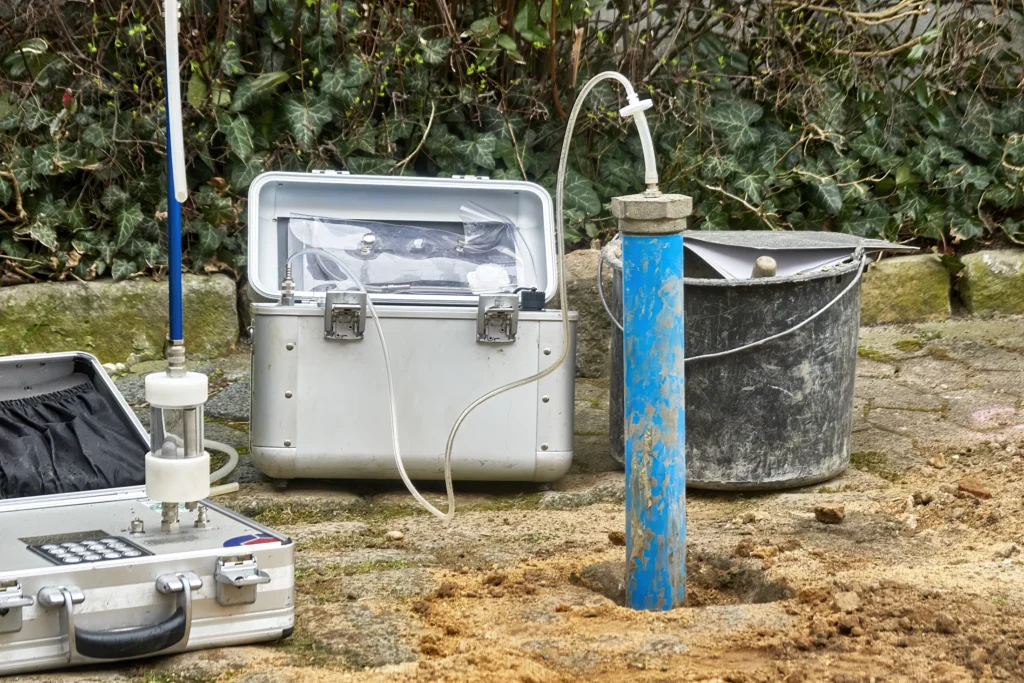
The word survey can describe a walkover or a wider investigation, so the intended work needs to be clear. Where sampling is required, locations, depths and analysis are chosen for the suspected source and the decision the results need to support.
Observations are tied to the site plan and used to identify any follow-up work. A visual inspection improves the evidence for the land assessment but does not replace intrusive investigation where buried conditions need to be tested.
Suspect demolition material and asbestos
If asbestos is suspected in demolition material or made ground, sampling and disturbance need competent planning so the investigation does not create avoidable exposure. Laboratory analysis may be needed to establish whether asbestos is present in the material being investigated.
Contaminated Land Survey: common questions
Does a contaminated-land survey always include soil samples?
No. The scope should specify whether it is a walkover or an intrusive investigation with sampling.
Can a visual survey prove there is no contamination?
No. Buried or dissolved contamination may have no visible surface evidence.
What makes a survey useful for later investigation?
Clear locations, observations, access limitations and a reasoned explanation of the questions still needing evidence.
What should happen where an area cannot be inspected?
The limitation should be recorded. Buildings, hardstanding or access restrictions can leave questions that need later investigation if they matter to the risk assessment.
How are sampling locations chosen?
Where sampling is required, locations and depths are selected to investigate the suspected source and the parts of the site that could affect the proposed use.